
CHARAIBETI
Electromyography-Controlled Wheelchair
Assistive Technology • Biomedical Engineering • Embedded Systems
This project has been selected for the 14th National Biennial Competition under the National Innovation Foundation–India, an autonomous body under the Department of Science and Technology, Government of India.
Introduction
The EMG-Controlled Wheelchair is a smart mobility solution designed for individuals with mobility impairments. It utilizes electromyography signals to control the movement of the wheelchair, allowing users to navigate their surroundings using muscle activity.
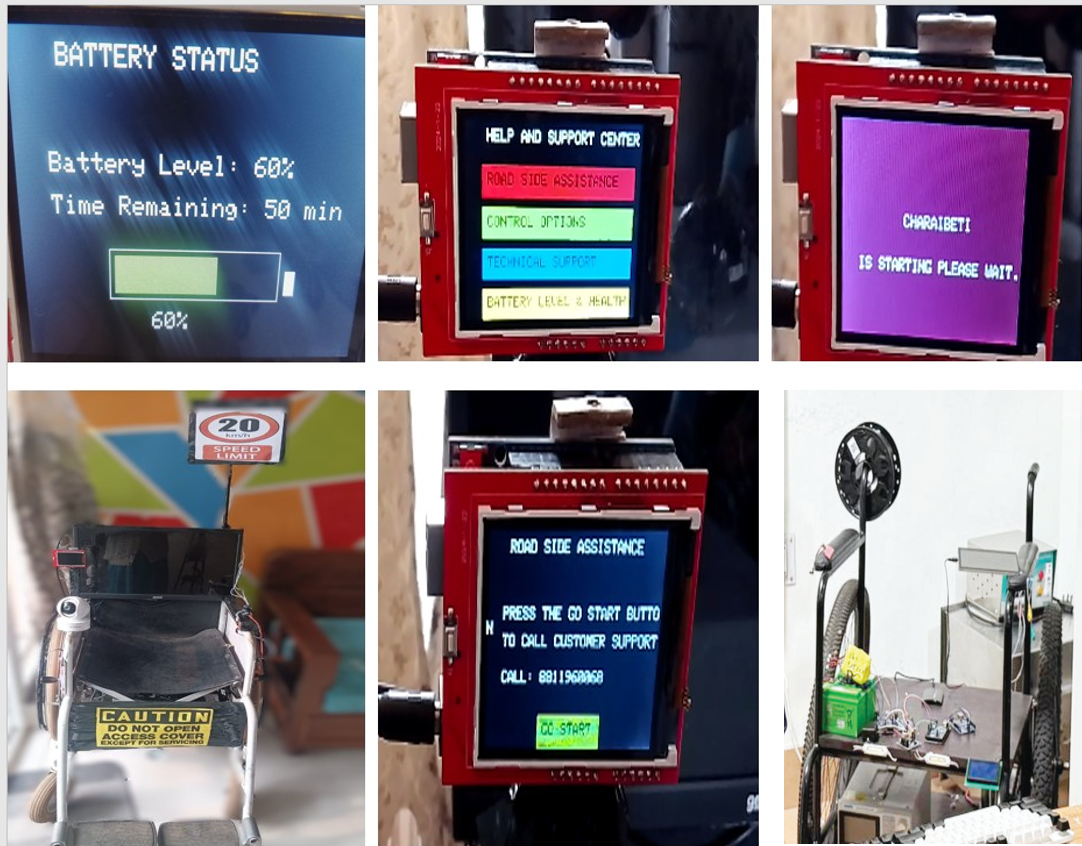
CHARAIBETI combines biomedical signal acquisition, microcontroller-based processing, high-current motor control and an interactive display system to support assistive mobility. A joystick is retained as a backup control method, while a touchscreen interface is being developed for system status, settings and assistance functions.
Objective
The primary objective of this project is to develop a hands-free wheelchair system that provides independence to users by detecting muscle signals and translating them into motion commands.
Current Development Status
CHARAIBETI is currently in the early prototype development stage and is approximately 10–20% complete. Major progress achieved so far includes the procurement of essential electronic and mechanical components, fabrication of the main wheelchair frame, implementation of joystick and touchscreen controls, and successful installation and testing of the drive motors.
Recognition and Selection
14th National Biennial Competition
The Electromyography-Controlled Wheelchair entry was accepted under the National Innovation Foundation–India, an autonomous body under the Department of Science and Technology, Government of India.
View NIF Acceptance RecordWorking Principle
The electromyography sensor captures electrical activity generated by muscle contraction. The captured signal is amplified and filtered to reduce noise before being supplied to the Arduino Mega.
Based on the signal intensity and predefined threshold values, the Arduino processes the signal and maps it to a movement command. The motor driver then controls the wheelchair motors to move the wheelchair in the intended direction.
The complete EMG control system is currently under development. At the present stage, the motors and mechanical platform are being operated and tested through joystick and touchscreen-based controls.
Implementation
- The EMG sensor detects muscle signals through surface electrodes.
- The captured signals are amplified and filtered to reduce electrical noise.
- The Arduino Mega processes the signals and maps them to movement commands.
- The BTS7960 motor driver controls the wheelchair motors according to the processed command.
- The touchscreen display presents real-time system status, assistance options and battery information.
- A joystick provides manual backup control during development, calibration and safety testing.
Features
Advantages
Components Used
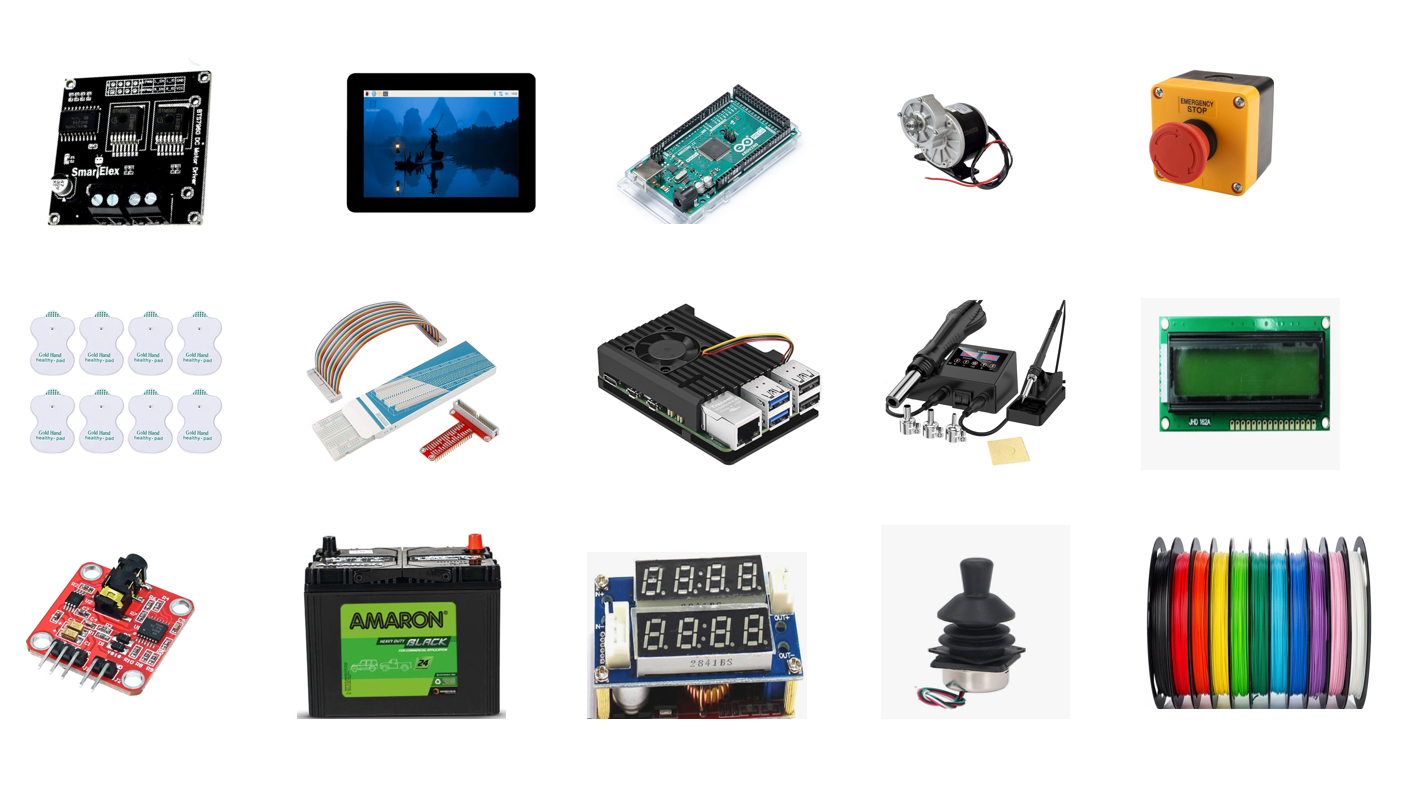
- SmartElex BTS7960 DC Motor Driver Module
- Raspberry Pi 5 Display
- Arduino Mega 2560
- MY1016Z3 Motor
- Surface Electrodes
- GIPO Circuit Board
- Raspberry Pi 5 with 8 GB RAM
- Soldering Station
- I2C Display
- Electromyography Sensor
- 24 V Amaron Battery
- XL4015 5 A Variable Voltage and Current Step-Down Module
- Joystick
- Emergency-Stop Switch
- 3D-Printer Filament
Development Results
The project is presently approximately 10–20% complete. The acquired components, fabricated frame, touchscreen interface, joystick control and drive motors have been assembled or tested successfully. EMG-based movement control, signal calibration, automation, final safety systems and complete prototype validation remain under development.
Challenges
- Signal-noise interference during electromyography acquisition.
- Calibration for users with different muscle strengths.
- Battery-efficiency and power-management optimization.
- Safe integration of EMG control with the already implemented joystick and touchscreen systems.
- Complete load testing and user-specific validation of the wheelchair.
Future Scope
- Completion of EMG-based movement control and user-specific signal calibration.
- Integration with artificial intelligence for improved muscle-signal processing.
- Wireless control and configuration through smartphone applications.
- Improved battery-management and range-estimation system.
- Voice-controlled assistance.
- Advanced collision avoidance and emergency safety features.
Proprietary Project — All Rights Reserved
CHARAIBETI and the Electromyography-Controlled Wheelchair project are not open source. The project design, documentation, software, source code, control logic, circuit architecture, hardware arrangements, images, interface designs and technical material may not be copied, reproduced, modified, redistributed, reverse-engineered or used commercially without prior written permission, except where permitted by applicable law.