
VAANI
Voice-Assisted Autonomous Navigation Interface
Physical AI • Voice-Controlled Robotics • Autonomous Navigation
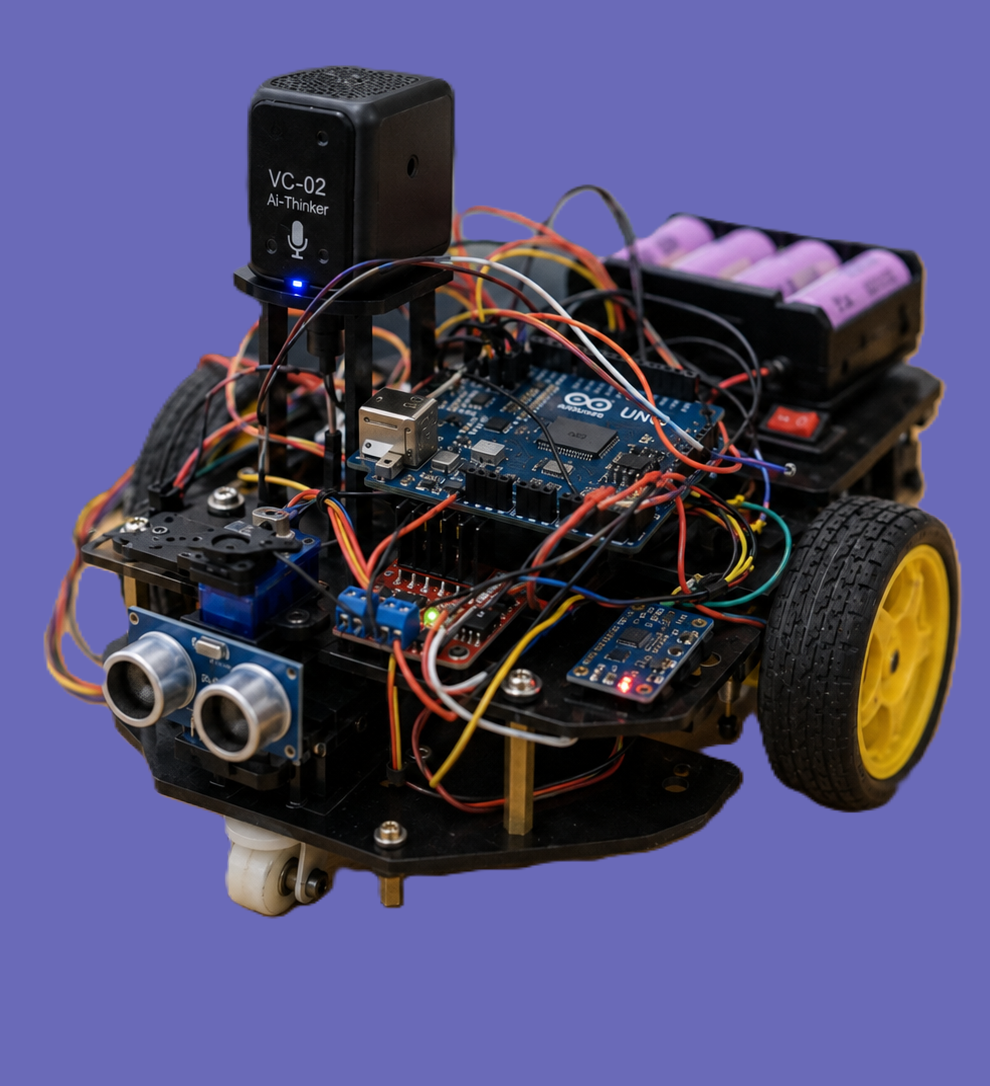
VAANI is a compact robotic platform designed to respond to offline voice commands and navigate autonomously. It combines voice recognition, ultrasonic obstacle detection, motion sensing, motor control and intelligent navigation logic in a single physical-AI system.
Introduction
Voice-based human–machine interaction can make robotic systems easier and more natural to control. However, voice-controlled robots may become unreliable when they depend completely on internet connectivity or remote cloud processing.
VAANI was conceptualised as a Voice-Assisted Autonomous Navigation Interface that can receive commands through an offline speech-recognition module and perform physical movement using an embedded robotic platform.
The robot is intended to support two principal operating modes. In voice mode, the user can issue movement instructions such as forward, backward, left, right and stop. In autonomous mode, the robot can observe nearby obstacles and modify its movement without requiring continuous human control.
Abstract
VAANI is a mini robotic platform designed to integrate offline voice recognition with autonomous obstacle avoidance. The Ai-Thinker VC-02 module recognises predefined spoken commands and sends the recognised instruction to the main controller.
The Arduino UNO Q processes the command and controls the TB6612FNG dual-motor driver. The motor driver operates the two geared DC motors used for forward, backward and turning movements.
An HC-SR04 ultrasonic sensor measures the distance to nearby obstacles. A servo mechanism can rotate the sensor to observe different directions, while the MPU6050 provides acceleration and orientation data.
The project demonstrates physical artificial intelligence by combining voice-based interaction, environmental sensing and autonomous robotic action.
Objectives
Features
System Architecture
Voice Recognition
The Ai-Thinker VC-02 recognises predefined offline commands and sends the command identity to the controller.
Obstacle Detection
The HC-SR04 measures distance by transmitting an ultrasonic pulse and timing the returning echo.
Orientation Sensing
The MPU6050 provides acceleration and gyroscopic information for movement and tilt observation.
Arduino UNO Q
The controller combines commands and sensor readings and determines the required robotic action.
TB6612FNG Driver
The motor driver controls motor direction and speed without passing the motor current through the controller.
Two-Wheel Platform
Two geared motors and a support wheel provide forward, reverse and differential turning movement.
Scientific and Working Principle
In voice-assisted mode, the VC-02 module continuously listens for its configured wake word and predefined commands. When a recognised command is detected, the module sends the corresponding command signal to the main controller.
The controller interprets the command and sends direction and speed signals to the TB6612FNG motor driver. The motor driver then controls the left and right motors to produce the requested motion.
In autonomous mode, the HC-SR04 measures the distance in front of the robot. When an obstacle is too close, the robot stops and scans the available directions. It then selects a direction with greater free space and continues moving.
The MPU6050 can provide tilt and motion information. If the robot experiences excessive tilt or an unstable condition, the controller can stop the motors to reduce the risk of damage.
Interactive VAANI Simulation
Select a command and send it to the virtual robot. You can also use the browser voice-input button where supported. Adjust the obstacle distance and robot tilt to test the autonomous protection logic.
Voice and Navigation Controls
Navigation Dashboard
System Outputs
Command and Navigation Log
Browser voice input depends on browser support. The simulation does not control a physical robot.
Components Used
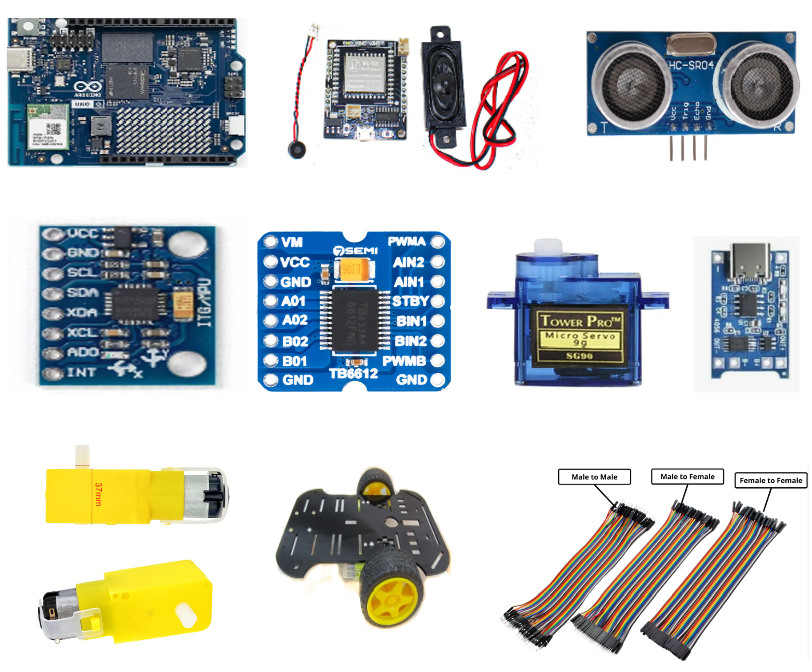
- Arduino UNO Q Development Board
- Ai-Thinker VC-02 Offline Voice Module
- HC-SR04 Ultrasonic Distance Sensor
- MPU6050 Accelerometer and Gyroscope
- TB6612FNG Dual-Motor Driver
- Servo Motor for Sensor Scanning
- Two Geared TT or BO Motors
- Two-Wheel Robotic Chassis
- Wheels and Support Caster
- Rechargeable Battery System
- Voltage-Regulation Module
- Main Power Switch
- Jumper Wires and Connectors
- Prototype PCB or Breadboard
- Custom 3D-Printed Parts
- USB Programming Cable
Technical Description
The Arduino UNO Q functions as the primary controller and coordinates voice commands, ultrasonic distance measurements, MPU6050 readings and motor operation.
The VC-02 is configured with selected offline voice commands. After recognising a command, it communicates the command identity to the main controller. This avoids requiring continuous internet access for ordinary movement commands.
The TB6612FNG controls the direction and speed of both motors. Differential movement allows the robot to turn by operating the motors in different directions or at different speeds.
The ultrasonic sensor measures distance using the time-of-flight of reflected sound waves. Mounting the sensor on a servo allows the robot to compare available space in multiple directions before turning.
| Component | Primary Function | Role in VAANI |
|---|---|---|
| Arduino UNO Q | Main processing platform | Processes commands, sensors and robotic navigation decisions |
| Ai-Thinker VC-02 | Offline speech recognition | Recognises configured voice commands |
| HC-SR04 | Distance measurement | Detects obstacles in the robot’s path |
| MPU6050 | Acceleration and rotation sensing | Observes movement, orientation and tilt |
| TB6612FNG | Dual-motor control | Controls motor direction and speed |
| Servo Motor | Sensor-direction control | Rotates the ultrasonic sensor for scanning |
| Geared DC Motors | Mechanical movement | Drive the left and right wheels |
| Battery and Regulator | Electrical power | Supplies suitable power to control and motor circuits |
Control Modes
Voice-Assisted Control
The user gives configured spoken commands such as forward, backward, left, right and stop. The VC-02 recognises the command and communicates it to the controller.
Autonomous Navigation
The robot continuously monitors the route and automatically stops, scans and changes direction when an obstacle is detected.
Emergency Stop
The controller stops both motors when it receives a stop command, detects an unstable tilt or encounters a protected obstacle condition.
Methodology
- Define the voice commands, autonomous functions and safety behaviour required for the robot.
- Select the Arduino UNO Q as the primary processing platform.
- Configure and test offline commands using the Ai-Thinker VC-02 module.
- Assemble the two-wheel chassis, geared motors and TB6612FNG motor driver.
- Test forward, backward and differential turning movements.
- Integrate the HC-SR04 ultrasonic sensor and measure obstacle distance.
- Add servo-based directional scanning for autonomous path selection.
- Integrate the MPU6050 for motion and orientation observation.
- Develop voice-assisted and autonomous navigation software.
- Design and fabricate the enclosure, PCB and mechanical mounting parts.
- Test voice commands, obstacle avoidance, emergency stopping and mode switching.
Current Development Areas
VAANI is an ongoing project. Its development involves electronic integration, software programming, motor control, offline speech recognition, autonomous navigation, PCB design, 3D modelling and fabrication of custom parts.
Concept and Architecture
DefinedThe main operating modes, control architecture, sensor system and robotic platform have been identified.
Component Integration
In ProgressIntegration of the controller, voice module, ultrasonic sensor, MPU6050 and motor driver is part of the continuing development process.
Voice-Command System
In ProgressOffline command configuration and reliable communication between the voice module and main controller are under development.
Autonomous Navigation
In ProgressObstacle measurement, directional scanning and automatic navigation logic are being developed and refined.
PCB and Circuit Design
DevelopmentA structured circuit and compact PCB arrangement are part of the planned product-development process.
Enclosure and 3D Parts
PlannedCustom 3D-modelled and 3D-printed parts will support the sensors, controller and final robot enclosure.
Future Scope
- Develop natural-language commands beyond fixed movement instructions.
- Add object and person detection through an AI-enabled camera.
- Introduce room mapping and path-planning functions.
- Add location memory and command-based destination selection.
- Integrate environmental and safety sensors.
- Develop a custom mobile or computer control dashboard.
- Add battery-level observation and automatic charging.
- Improve voice recognition in noisy environments.
- Develop multilingual offline command support.
- Adapt the platform for assistive, educational and indoor-service applications.
Proprietary Project — All Rights Reserved
VAANI is not an open-source project. Its design, documentation, software, voice-command structure, autonomous-navigation logic, circuit architecture, PCB designs, 3D models, images and technical material may not be copied, reproduced, modified, redistributed, reverse-engineered or used commercially without prior written permission, except where permitted by applicable law.