
A Cheap and User-Friendly Wastewater Filter
For Application in Flood-Prone Regions to Mitigate Water Crisis During Emergencies
Environmental Engineering • Emergency Water Treatment • Low-Cost Filtration
The project report describes an affordable filtration candle constructed from locally available materials. During the reported experiment, 50 litres of IIT Guwahati lake water were filtered. The study reported a major reduction in turbidity, total solids, heavy-metal concentration and viable bacterial contamination.
Abstract
This project reports an efficient and affordable wastewater filter intended for use during emergency situations without requiring specialised technical knowledge. The filter candle is constructed from readily available materials including pebbles, sand, activated charcoal, celite or diatomaceous earth, cotton, nylon mesh and plastic containers.
The filtration system was tested by passing 50 litres of water collected from a lake inside the Indian Institute of Technology Guwahati campus. According to the project report, the developed filter removed 99.99% of viable bacteria and substantially reduced total solids, turbidity and heavy-metal concentrations.
The filtered sample was compared with drinking water produced by a commercial UV-RO filter. The study reported that the developed system produced water that met the parameters compared in the experiment and could support emergency water access in flood-prone regions.
Important Water-Safety Notice
The reported results apply to the specific prototype and IIT Guwahati lake-water samples tested in the study. A homemade filter should not automatically be assumed to make every floodwater source safe for drinking. Emergency use should include validated disinfection and water-quality verification by an appropriate laboratory or public authority.
Introduction
Floods affect large geographical areas of India, particularly parts of Assam, Bihar and West Bengal. Assam is surrounded by the Brahmaputra and Barak river systems, making many districts vulnerable to severe monsoon flooding.
Flooding damages homes, roads, agriculture, sanitation systems and sources of clean water. Rural communities may be forced to move to relief camps, while some affected locations remain inaccessible because of difficult terrain and waterlogged roads.
When hygienic water is unavailable, affected people may be forced to use contaminated floodwater for sanitation, bathing and drinking. This can increase the risk of waterborne infections. Portable emergency filters should therefore be affordable, efficient, user-friendly and made from materials that are readily available.
The aim of this project was to develop a cheap and effective wastewater filtration candle that could be assembled from locally available materials and used without advanced technical knowledge.
Contaminated Water
Floodwater may contain suspended matter, microorganisms, domestic runoff and other contaminants.
Difficult Access
Relief supplies and commercial purification systems may not reach isolated communities immediately.
Affordability
Many commercially available water-treatment technologies are expensive or difficult to operate during emergencies.
Developed Filtration System
Materials and Methods
Filter-Construction Materials
- White sand
- Pebbles
- Activated charcoal grains
- Diatomaceous earth or celite
- Standard plastic containers
- M-Seal
- Fevicol
- Rubber washers
- Fine nylon mesh
- Non-adsorbent cotton roll
- Adsorbent cotton
- Butter paper
Water-Quality Testing Materials
- Laminar airflow unit
- Agar medium
- Sterile Petri plates
- Glass spreaders
- Laboratory incubator
- Ice box
- Sterilised sample containers
- Multi-parameter water-quality meter
- HI98194 HANNA Instruments meter
- Laboratory glassware
Construction of the Filtration System
The filtration system was designed in the form of a candle similar to the candles used in commercial water filters. It was constructed from two plastic containers, each approximately 10 cm long, producing a combined candle length of approximately 20 cm.
The two main containers were divided into four filtration sub-compartments. Rubber washers, hardware fittings and M-Seal were used to join the containers and make the candle leak-proof.
Empty spaces of approximately 4 cm were retained in selected sections to help maintain water pressure and provide additional contact or delay time during filtration.
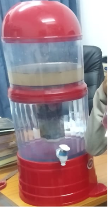
For testing, the commercial candle of a commonly available filter body was replaced with the developed candle. A flow rate of approximately 10 litres per hour was maintained while filtering 50 litres of lake water.
The report states that no clogging was observed even after the continuous filtration of the complete 50-litre sample.
Experimental Methodology
- Collect water from the IIT Guwahati lake at a depth of approximately 1.5 feet using clean, sterilised and properly labelled containers.
- Collect three sample volumes: 50 litres for filtration, 1 litre for physicochemical testing and 0.5 litre for bacteriological analysis.
- Store the bacteriological sample in an ice box during transportation and allow it to return to room temperature before testing.
- Assemble the two-container filtration candle with pebbles, sand, charcoal, celite, cotton, butter paper and nylon-mesh layers.
- Seal the filtration candle using hardware fittings, rubber washers and M-Seal to prevent leakage.
- Replace the candle of a common filter body with the developed filtration candle.
- Pass 50 litres of untreated lake water through the system at a constant flow rate of approximately 10 litres per hour.
- Compare raw lake water, water from the developed filter and drinking water from a commercial UV-RO filter.
- Analyse colour, odour, pH, salinity, TDS, total solids, conductivity, turbidity, dissolved oxygen, selected heavy metals and bacterial growth.
Interactive Filtration Simulation
Start the simulation to follow the water through the reported filtration layers. The water-quality dashboard uses the values presented in the project’s experimental table. It is a visual demonstration and not a substitute for actual laboratory testing.
Filtration Progress
Ready to begin the filtration demonstration.
Water-Quality Sample
Results and Water-Quality Analysis
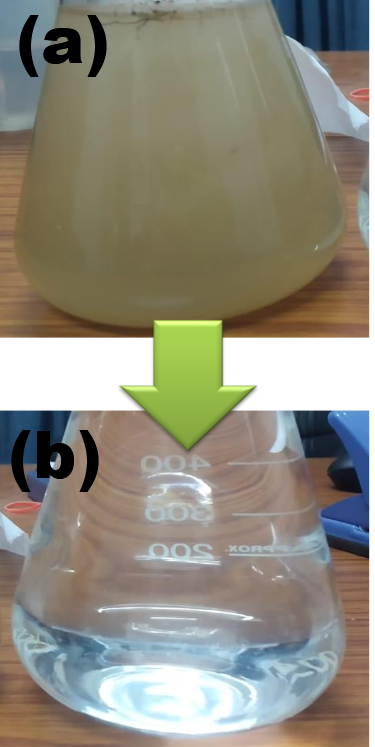
The untreated lake water was described as pale yellow with a slightly pungent odour. After filtration through the developed system, the collected water was reported to be colourless and odourless.
The physicochemical and bacteriological results reported for the untreated lake water, water from the developed filtration system and drinking water from a commercial filter are presented below.
| Parameter | Lake Water | Developed Filter | Commercial Filter | Unit | Referenced Standard |
|---|---|---|---|---|---|
| Physicochemical Report | |||||
| Colour | Pale Yellow | Colourless | Colourless | NA | Colourless |
| Odour | Slight Pungent | Odourless | Odourless | NA | Odourless |
| pH | 8.07 | 7.47 | 7.47 | NA | 6.0–8.5 |
| Salinity | 0.10% | 0.09% | 0.09% | NA | — |
| Total Dissolved Solids | 195.1 | 95.1 | 90.8 | mg/L | <500 mg/L |
| Total Solids | 398.5 | 95.1 | 90.8 | mg/L | <1000 mg/L |
| Conductivity | 390.8 | 193.2 | 190.7 | µS cm⁻¹ | — |
| Turbidity | 50 | 1 | 1 | NTU | <5 NTU |
| Dissolved Oxygen | 6.55 | 7.29 | 7.58 | mg/L | >6 mg/L |
| Heavy-Metal Report | |||||
| Copper | 0.137 | 0.001 | 0.001 | mg/L | <1.5 mg/L |
| Iron | 0.762 | 0.052 | 0.042 | mg/L | <0.3 mg/L |
| Lead | 0.340 | 0.001 | 0.001 | mg/L | <0.1 mg/L |
| Bacteriological Report | |||||
| Total Bacterial Count | Mat | No detectable colony | No detectable colony | CFU/mL | <50 MPN |
Microbial Analysis
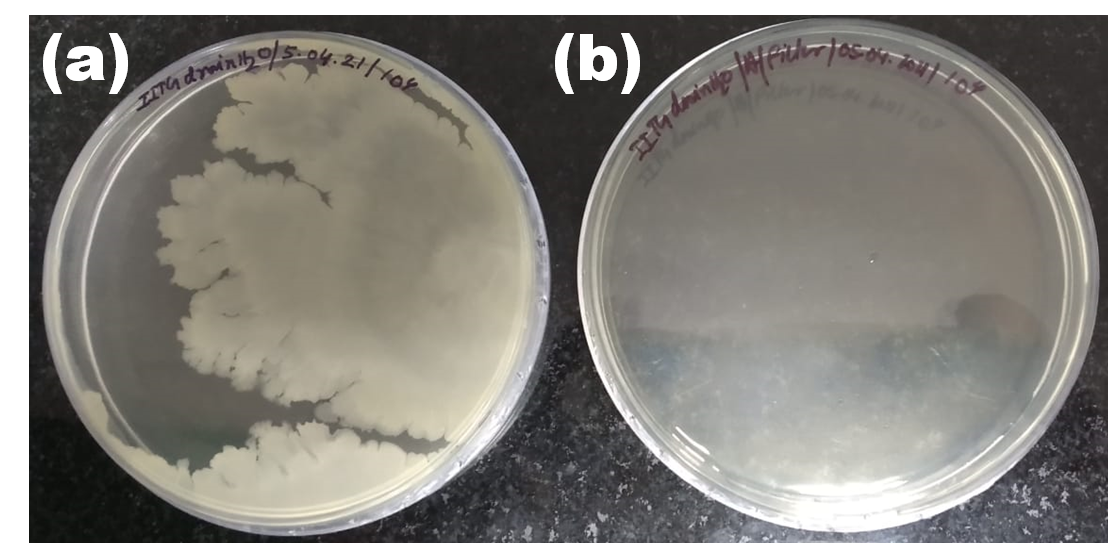
The spread-plate technique was used to compare bacterial growth in untreated lake water and water collected after filtration. The untreated sample produced a visible mat of bacterial colonies.
The project report states that no detectable bacterial or microbial colony was observed on the plate prepared from water collected after filtration through the developed system.
Discussion
- The pH changed from 8.07 in untreated lake water to 7.47 after filtration, matching the value reported for the commercial-filter sample.
- Total dissolved solids decreased from 195.1 mg/L to 95.1 mg/L, while the commercial-filter sample measured 90.8 mg/L.
- Turbidity was reduced from 50 NTU to 1 NTU, the same value reported for water from the commercial filter.
- Conductivity decreased from 390.8 µS cm⁻¹ to 193.2 µS cm⁻¹, close to the commercial-filter value of 190.7 µS cm⁻¹.
- Dissolved oxygen increased from 6.55 mg/L to 7.29 mg/L after filtration.
- The reported concentrations of copper, iron and lead were substantially lower after filtration.
- The untreated sample produced extensive bacterial growth, while no detectable colony was reported for the filtered sample.
- No clogging was reported after continuously filtering the complete 50-litre lake-water sample.
Intended Applications
Open-Source Project Resources
The filtration design, layer arrangement, construction guide, material list, technical documentation, experimental information and project photographs are available through the Open Source Section.
Conclusion
The filtration system was designed using inexpensive and locally available materials. The reported analysis found that the system substantially reduced turbidity, total solids, conductivity, selected heavy-metal concentrations and detectable bacterial contamination in the tested lake-water sample.
The filtered sample was compared with drinking water produced by a commercial UV-RO filter and showed similar values for several parameters measured in the study. The report therefore concludes that the filter has potential as a cheap and user-friendly emergency filtration system for flood-prone regions.
Further field deployment should include standardised manufacturing, validated disinfection procedures, independent water-quality testing and regular replacement of filtration media.
Responsible Emergency Use
Water appearance alone cannot establish drinking safety. Actual emergency deployment must consider the local source, biological contaminants, chemicals, filter condition, contact time, disinfection and laboratory confirmation.
Open-Source Environmental Project
The Low-Cost Wastewater Filter is released as an open-source educational and research project. Its filter design, layer arrangement, construction documentation, material information and supporting resources may be studied, reproduced and modified in accordance with the licence and attribution requirements provided in the Open Source Section. Modified versions should be clearly identified and must not be represented as certified drinking-water systems without appropriate testing and approval.